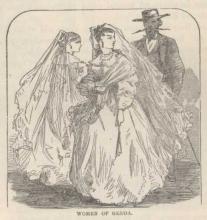
Mark Twain travels to Italy and first lands at Genoa. He's not impressed by the architecture but the women capture him. I'm trying a different slideshow program with this chapter, Imagination. It uses ffmpeg to render the slideshow and as with the other programs has problems with the color rendition of the pictures but it has a large number of transformation functions to choose from. Note the brown sky around the cathedral, the original photo has blue sky. Also, the faces in the painting of Le Moulin are blue tinged rather than flesh toned, as found in the painting.
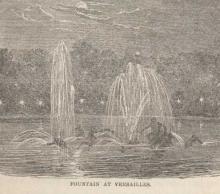
Twain is enraptured by Versailles. This is a rather interesting shift for Twain. Previously he has complained of the "worship of man" exhibited in the paintings of the "old masters" while here we have him waxing poetical over the works of man. He goes so far as to compare the gardens of Versailles with the Garden of Eden. It seems he even forgives the cost in human life it took to build the place.
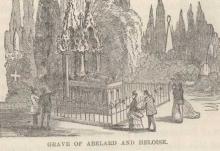
Twain visits two "burying-grounds" in Paris, Pere la Chaise and St. Denis. He remarks on the ancient rulers of France, Dagobert, Clovis and Charlemagne, in St. Denis, and "the last home of scores of illustrious mean and women who were born to no titles, but achieved fame by their own energy and their own genius" in Pere la Chaise. Charlemagne was not interred at St. Denis but at Aachen Cathedral in modern day Germany. The tomb of Abelard and Heloise is found in Pere la Chaise and is a place of pilgrimage for the broken hearted.
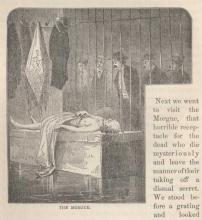
Sight seeing in Paris, Mark imagines the scenes viewed by those saints found on the wall of Notre Dame. He visits the morgue and ponders the life and death of a drowned man stretched upon a slab. He is both shocked and drawn to the "outrageous" can-can. Some of the material for this chapter can be found in original form in letter Number Five published in the Daily Alta California, discussed in chapter 6 of McKeithan (1958). Portions of the letter can also be found in Chapters 12, 13 and 16 of the book.
I'd recently found a Facebook posting of a TED talk, that reminded me of something someone said sometime in the 70's, "I never listen to any music I haven't heard before." The TED talk concerns something called the filter bubble an artifact of the way search engines operate. They use algorithms that select items that are expected to be of interest to the user and effectively filter out the rest. Effectively resulting in a dumbing down of users. Users will not be exposed to things they haven't previously encountered. The phrase knowledge entropy occurred to me.
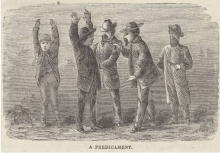
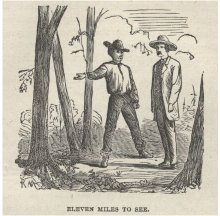
This is the final chapter of Roughing It. His friends play a practical joke on him by staging a midnight highway robbery, on a very cold night. It backfires. He decides to "go home" again, but then again one never can and he decides to head on on the adventure recounted in his book The Innocents Abroad.
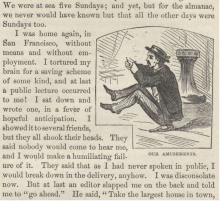
Twain returns from Hawaii, a relatively uneventful trip. Now being unemployed he decides to try out public speaking. We hear how he dealt with stagefright.
Twain recounts his encounters with an extreme liar and tells of the liar's strange fate.
Subscribe to
© 2026 B Scott Holmes, All rights reserved.